Project Success Metrics
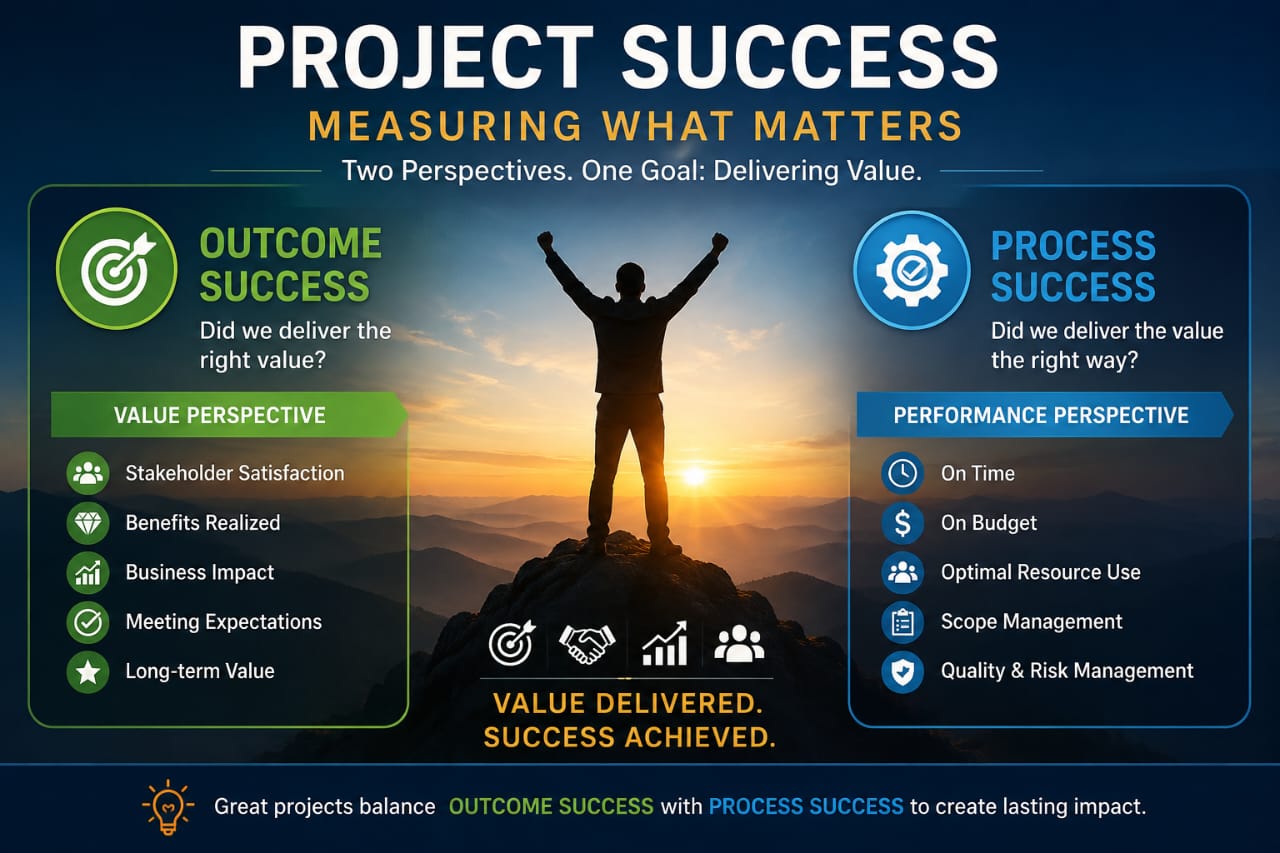
In project management, project success can be viewed from two complementary perspectives:
1. outcome success
2. process success.
Both are important, but they answer different questions about whether a project has truly been successful.
Outcome success focuses on the value and benefits ultimately realized by the stakeholders.
In simple terms, it asks: Did the project achieve what it was intended to achieve, and did it satisfy the expectations of those who matter?
A project may be completed exactly according to its original plan, yet still fail from an outcome perspective if it does not deliver meaningful value.
For example, a project could be delivered on time and within budget, but if the resulting product does not solve the customer's problem, improve business performance, or generate the expected benefits, can we really call the project successful?
This is why modern project management increasingly emphasizes value delivery and stakeholder outcomes, rather than simply measuring whether the project team completed the planned activities. The real measure of success is not merely what we delivered, but what value that delivery created.
Process success, on the other hand, focuses on how the project was delivered. It considers the project's performance against the constraints and objectives established for its execution. These may include cost, schedule, scope, quality, resources, risk, and other project-specific constraints.
Process success therefore asks questions such as:
- Was the project delivered within the approved budget?
- Was it completed within the agreed schedule?
- Was the required scope delivered?
- Were resources utilized effectively?
- Were quality requirements satisfied?
- Were risks and issues appropriately managed?
- Were changes properly controlled?
- Were stakeholders effectively engaged throughout the project?
While outcome success tells us whether the project created the intended value, process success gives us significant insight into how effectively the project was managed to achieve that value.
This distinction is particularly important when evaluating the performance of the project manager. A project manager may inherit a project with unrealistic deadlines, inadequate resources, an insufficient budget, or an unstable scope. In such circumstances, the final outcome may be affected by factors beyond the project manager's direct control.
However, the way the project manager responds to these constraints, through planning, risk management, stakeholder engagement, communication, resource optimization, governance, decision-making, and change management can provide a much clearer indication of their professional and technical competence.
That said, process success should not become an excuse for poor outcomes.
A project manager can be exceptionally good at controlling schedules, budgets, risks, and resources and still deliver a project that ultimately provides little value. Conversely, a project may exceed its original budget or schedule yet produce enormous strategic value for the organization.
This brings us to an important question:
Should a project that is delivered late and over budget, but creates significant business value, be considered more successful than a project delivered on time and within budget but produces little or no value?
There may not be a universal answer. Project success is contextual and should be evaluated against the strategic objectives, stakeholder expectations, benefits, and circumstances of the project.
Ultimately, I believe project success should not be reduced to the traditional iron triangle of scope, time, and cost. Those measures remain important, but they are indicators of delivery performance rather than the complete definition of success.
A truly successful project should ideally demonstrate both:
1. Delivery excellence — the project was managed effectively within its relevant constraints.
2. Value realization — the project produced the intended outcomes and benefits for its stakeholders.
In other words, a project manager's job is not simply to deliver the project; it is to facilitate the delivery of value through the project.
And perhaps this is where the distinction becomes most important: process success tells us how well we managed the project, while outcome success tells us whether what we managed was actually worth delivering.
What are your thoughts? Which should carry greater weight when evaluating project success; the way the project was delivered or the value ultimately created?